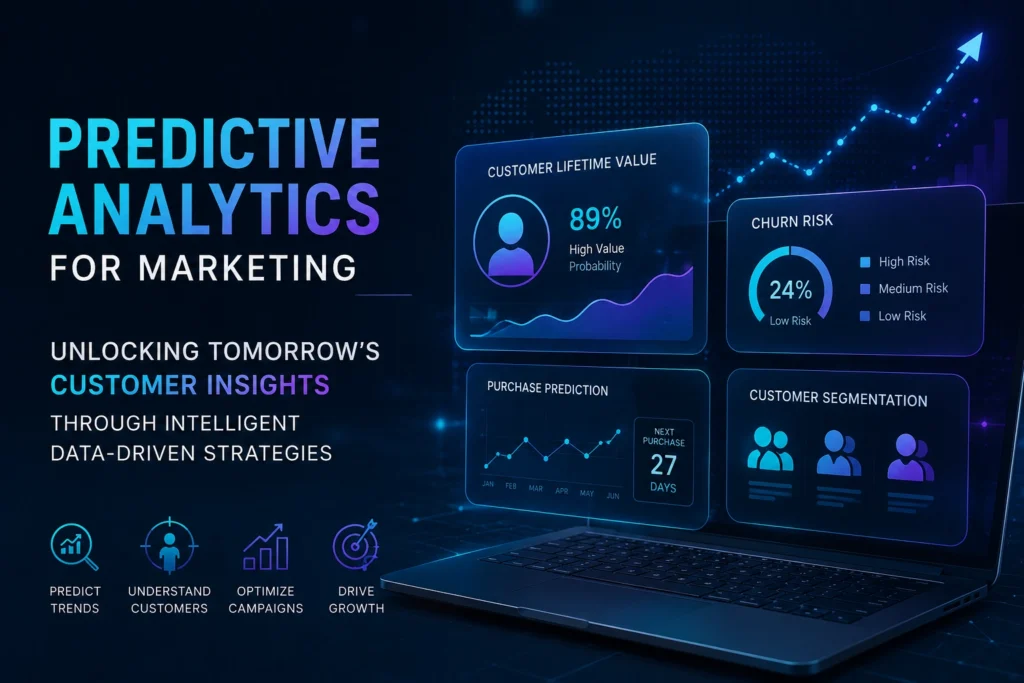
Predictive Marketing Analytics: Unlocking Tomorrow’s Customer Insights Through Intelligent Data-Driven Strategies
Introduction: The Evolution of Marketing Through Predictive Analytics Over the past few decades, marketing has undergone substantial change. Traditional marketing methods primarily relied on historical data, intuition, and broad demographic assumptions to reach potential customers. However, the rapid growth of digital technologies has transformed how businesses understand consumer behavior. Today, organizations generate massive volumes of customer data every second, creating opportunities to make more informed marketing decisions. Consequently, predictive analytics has emerged as one of the most powerful tools for modern marketers. Predictive Marketing Analytics enables businesses to anticipate customer needs, forecast future trends, and optimize marketing campaigns with remarkable precision. Instead of merely reacting to customer actions, organizations can proactively identify opportunities before they occur. As a result, companies improve customer experiences, increase operational efficiency, and maximize return on investment. Therefore, predictive analytics has become a fundamental component of successful marketing strategies across industries. Understanding Predictive Analytics in Marketing Predictive analytics refers to the practice of using statistical algorithms, machine learning models, historical data, and artificial intelligence to forecast future outcomes. Rather than focusing exclusively on past performance, predictive models identify patterns that indicate what customers are likely to do next. Consequently, marketers gain valuable insights that support strategic decision-making. In marketing, predictive analytics analyzes customer behavior, purchasing habits, website interactions, social media engagement, and transaction history. Subsequently, businesses use these insights to predict customer preferences, identify high-value prospects, estimate future sales, and personalize marketing communications. Therefore, predictive analytics transforms raw data into actionable intelligence that drives measurable business growth. Why Predictive Analytics Matters in Modern Marketing Modern consumers expect personalized experiences across every interaction. Generic advertising campaigns often fail because customers seek relevant content that aligns with their unique preferences. Therefore, predictive analytics helps marketers deliver customized messages at the right moment through the right communication channels. Furthermore, competition continues to increase across nearly every industry. Businesses must make smarter decisions while optimizing limited marketing budgets. Predictive analytics enables organizations to identify which customers are most likely to convert, which campaigns will produce the highest returns, and which marketing channels deserve additional investment. Consequently, companies reduce unnecessary spending while improving campaign effectiveness. Key Components of Predictive Analytics Successful predictive analytics relies on several interconnected components that work together to generate reliable forecasts. First, organizations collect high-quality data from multiple sources, including websites, customer relationship management systems, social media platforms, email campaigns, and sales transactions. Without accurate data, predictive models cannot deliver meaningful insights. Second, advanced analytical models process the collected information using statistical techniques and machine learning algorithms. These models continuously learn from new data, allowing predictions to become increasingly accurate over time. Finally, visualization tools transform complex analytical outputs into understandable reports and dashboards. Therefore, marketing teams can interpret findings quickly and make informed decisions with confidence. Applications of Predictive Analytics in Marketing Predictive analytics supports numerous marketing activities that improve customer engagement and business performance. One of its most valuable applications involves customer segmentation. Instead of grouping customers solely by age or location, predictive models classify customers according to purchasing behavior, preferences, spending patterns, and future potential. Consequently, marketers create highly personalized campaigns that resonate with each audience segment. Another important application involves lead scoring. Based on the possibility that a customer would become a paying customer, predictive models assess customer encounters.. As a result, sales teams prioritize the most promising leads while marketing departments focus resources more efficiently. Additionally, predictive analytics supports recommendation engines, churn prediction, customer lifetime value estimation, pricing optimization, and campaign performance forecasting. Benefits of Predictive Analytics for Businesses Predictive analytics offers numerous advantages that strengthen marketing performance. First, it significantly improves customer targeting by identifying individuals who are most likely to respond positively to specific campaigns. Consequently, businesses increase conversion rates while minimizing wasted advertising expenses. Moreover, predictive analytics enhances customer retention. By identifying early signs of dissatisfaction or declining engagement, businesses can intervene before customers leave. Therefore, organizations strengthen customer loyalty through personalized offers, timely communication, and proactive customer service. In addition, predictive analytics supports better inventory planning, demand forecasting, and revenue optimization, creating long-term competitive advantages. Challenges and Limitations of Predictive Analytics Although predictive analytics delivers impressive benefits, organizations also encounter several implementation challenges. Data quality remains one of the most significant obstacles because incomplete, inaccurate, or inconsistent information reduces prediction accuracy. Therefore, businesses must establish effective data governance practices before implementing predictive models. Additionally, privacy regulations continue to evolve worldwide. Organizations must collect, store, and process customer data responsibly while complying with applicable legal requirements. Furthermore, predictive models require continuous monitoring because customer behavior changes over time. Consequently, businesses must regularly update algorithms to maintain reliable performance and avoid outdated predictions. Best Practices for Implementing Predictive Analytics Organizations should begin by defining clear business objectives before adopting predictive analytics. Rather than collecting excessive amounts of data without purpose, companies should identify specific marketing challenges they intend to solve. Consequently, analytical efforts remain focused and produce measurable business outcomes. Furthermore, businesses should invest in skilled professionals, appropriate technologies, and continuous employee training. Collaboration among marketing teams, data scientists, and information technology specialists ensures successful implementation. Additionally, organizations should regularly evaluate predictive model performance, validate results, and refine strategies based on new insights. Therefore, predictive analytics becomes an ongoing process of continuous improvement rather than a one-time project. The Future of Predictive Analytics in Marketing The future of predictive analytics appears increasingly promising as artificial intelligence, machine learning, and automation continue to advance. Emerging technologies will enable businesses to process larger datasets, generate more accurate predictions, and deliver real-time personalized customer experiences. Consequently, marketing campaigns will become even more responsive and customer-centric. Moreover, predictive analytics will increasingly integrate with conversational artificial intelligence, voice assistants, augmented reality, and Internet of Things devices. These innovations will generate richer customer insights while creating entirely new opportunities for personalized marketing. Therefore, organizations that embrace predictive analytics today will be better prepared to compete in tomorrow’s data-driven marketplace. Conclusion: Building Smarter Marketing Strategies with Predictive Analytics Predictive analytics has fundamentally transformed the marketing landscape